TIN ID Requirements in the Philippines 2026: Complete Eligibility and Documents Guide
Who Is Eligible to Apply for a TIN ID in the Philippines?
Filipino citizens, employees, students, unemployed individuals, freelancers, business owners, Overseas Filipino Workers (OFWs), and eligible foreign nationals can apply for a Taxpayer Identification Number (TIN) in the Philippines. The Bureau of Internal Revenue (BIR) determines eligibility based on employment status, business activities, tax obligations, or qualifying government transactions.
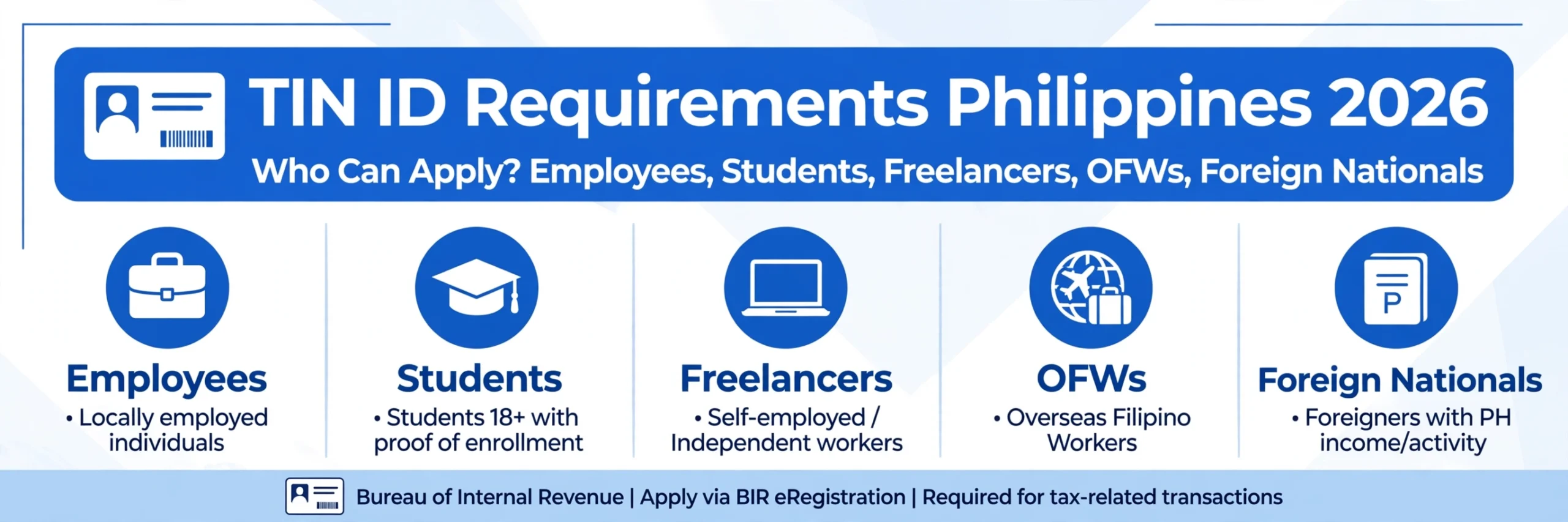
Applicants must meet the requirements for their taxpayer category. Individuals who already have a TIN can apply for a Digital TIN ID through BIR ORUS without obtaining another taxpayer number.
Employees and First-Time Job Holders
Filipino and foreign employees working in the Philippines are eligible for TIN registration because employers need their taxpayer numbers for income tax withholding and reporting.
Eligible applicants include:
- Newly hired employees starting their first job.
- Private-sector and government employees.
- Part-time and full-time employees earning compensation income.
- Foreign nationals legally employed in the Philippines.
First-time employees without an existing TIN generally register through their employer using the ORUS Employer Service Link. Employees who already have a TIN must continue using their existing number when changing jobs.
Unemployed Individuals and First-Time Job Seekers
Unemployed Filipinos can obtain a TIN without having a job if they need one for a qualifying government transaction under Executive Order No. 98 (E.O. 98).
Eligible applicants may include:
- Unemployed individuals completing government transactions that require a TIN.
- First-time job seekers who need a TIN for an eligible purpose.
- Individuals without taxable income who qualify under E.O. 98.
Applicants in this category generally use BIR Form 1904 for manual registration.
Being unemployed does not automatically require TIN registration. Applicants must have a valid registration purpose.
Students and Young Applicants
Students and young individuals may qualify for a Philippine TIN when they need one for an eligible transaction, even if they are not employed.
Common qualifying situations include:
- Students preparing for employment who have a qualifying registration purpose.
- Young applicants completing government transactions requiring a TIN.
- First-time job seekers who qualify under E.O. 98.
- Young individuals with taxable income or other tax-related obligations.
Students are not automatically required to obtain a TIN simply because they are enrolled in school.
For minors, registration may involve additional documentation or assistance from a parent or legal guardian, depending on the transaction and BIR requirements.
Freelancers, Online Sellers, and Self-Employed Individuals
Freelancers and self-employed individuals earning income from independent work or business activities must register with the BIR.
This category includes:
- Freelance writers, designers, and virtual assistants.
- Online sellers operating through e-commerce platforms.
- Content creators and digital service providers.
- Independent consultants and contractors.
- Individuals earning income from self-employed activities.
Self-employed applicants generally register using BIR Form 1901 for manual registration or the applicable business registration service through ORUS.
Individuals who earn both employment income and freelance income are classified as mixed-income earners.
Sole Proprietors and Licensed Professionals
Sole proprietors and professionals practicing their profession in the Philippines are required to register their taxable business or professional activities with the BIR.
Eligible applicants include:
- Owners of sari-sari stores and small retail businesses.
- Sole proprietors operating online or physical shops.
- Doctors, lawyers, accountants, and engineers.
- Licensed consultants and other practicing professionals.
- Individuals operating service-based businesses.
Sole proprietors use their personal TIN for business registration. They should not apply for a second TIN if they already have one.
Corporations, however, are separate legal entities and have their own business TIN registration requirements.
Overseas Filipino Workers (OFWs)
Overseas Filipino Workers may obtain a Philippine TIN when they have qualifying tax obligations or government transactions in the Philippines.
Situations where an OFW may need a TIN include:
- Completing government transactions requiring taxpayer identification.
- Registering a business or professional activity in the Philippines.
- Participating in taxable property or other one-time transactions.
- Meeting applicable Philippine tax reporting obligations.
OFWs who are not engaged in business may qualify for registration under E.O. 98, depending on the purpose.
Working overseas does not automatically require an OFW to obtain a Philippine TIN. Those who already have one should continue using their existing number.
Foreign Nationals, Resident Aliens, and Nonresident Individuals
Foreign nationals may obtain a TIN in the Philippines when they work, operate a business, receive certain Philippine-source income, or complete qualifying taxable transactions.
Eligible categories include:
- Resident aliens: Foreign nationals residing in the Philippines with applicable tax or registration obligations.
- Foreign employees: Non-Filipino individuals earning employment income in the Philippines.
- Foreign entrepreneurs: Individuals conducting business or professional activities in the country.
- Nonresident aliens: Foreign individuals receiving Philippine-source income or completing transactions that require a TIN.
The appropriate registration procedure depends on the applicant’s residency, employment, and tax classification.
For certain nonresident individuals receiving income subject to Philippine withholding tax, the withholding agent may apply for the TIN on their behalf.
A Philippine TIN does not grant immigration status, residency rights, or permission to work.
Corporations, Partnerships, and Other Registered Organizations
Corporations, partnerships, cooperatives, associations, and other covered organizations must register with the BIR when required for business operations, tax reporting, or government transactions.
Eligible organizations include:
- Domestic and resident foreign corporations.
- One-person corporations (OPCs).
- General and limited partnerships.
- Registered cooperatives and associations.
- Nonprofit and non-stock organizations.
- Estates, trusts, and other entities with applicable registration obligations.
Corporations, partnerships, and other covered organizations generally use BIR Form 1903 for manual registration. Estates and certain trusts follow separate registration requirements.
Important: Business TIN registration is different from obtaining a personal TIN ID. Registered organizations generally receive a BIR Certificate of Registration (Form 2303) where applicable, rather than an individual Digital TIN ID.
Individuals and organizations should verify their taxpayer classification through the official BIR website before applying.
What Are the General Requirements for a TIN ID?
Who Is Eligible to Apply for a TIN ID in the Philippines?
You may apply for a Taxpayer Identification Number (TIN) in the Philippines if you meet the BIR’s registration requirements. Eligibility is not limited to employed individuals. The BIR issues TINs for employment, business registration, government transactions, and other legally recognized purposes. This means that students, unemployed individuals, freelancers, sole proprietors, professionals, overseas Filipino workers (OFWs), and foreign nationals with qualifying activities in the Philippines may also be eligible to register.
However, eligibility depends on your taxpayer classification and purpose of registration. For example, unemployed individuals generally apply under Executive Order No. 98 (E.O. 98) for qualifying government transactions, while self-employed individuals register for business or professional income. Applying for a TIN without a valid registration purpose may result in rejection or unnecessary registration. Before applying, confirm whether your situation requires a TIN and identify the correct taxpayer category.
Core Documents Required for TIN ID Application
Most first-time TIN applicants in the Philippines must prepare the following basic documents:
- Valid government-issued ID: Such as a PhilID, passport, or driver’s license. The ID must show your full name, birthdate, and address, where applicable.
- BIR registration form: The form depends on your taxpayer category. For example, employees use BIR Form 1902, while self-employed individuals use BIR Form 1901.
- Proof of residence: This may be required if your ID does not show your current address. Acceptable proof may include a Barangay Certificate or utility bill, depending on BIR requirements.
- Additional supporting documents: Depending on your category, you may need a marriage certificate, employment certification, business registration certificate, or other transaction-related documents.
The BIR may require original documents and photocopies for manual applications, while online applicants through BIR ORUS must upload clear digital copies.
Additional Documents That May Be Required
In addition to a valid ID and the correct BIR form, some applicants need to provide:
- Marriage certificate: For married female applicants whose registered name has changed.
- Barangay Certification: For first-time job seekers and certain E.O. 98 applicants.
- DTI Certificate: For sole proprietors registering a business name.
- SEC Certificate: For corporations, partnerships, and other non-individual taxpayers.
- Professional Regulation Commission (PRC) ID: For licensed professionals.
- Authorization documents: Such as a Special Power of Attorney (SPA) if an authorized representative submits the application.
These additional documents depend on the applicant’s classification and registration purpose. Always check the official BIR documentary requirements checklist before applying.
What You Do Not Need to Apply for a TIN ID
Many first-time applicants believe they need employment, a business, or expensive requirements to get a TIN. In most cases, this is not true:
- You do not need a job to apply: Unemployed individuals can register under E.O. 98 for qualifying government transactions.
- You do not need a business to apply: A TIN is not only for business owners.
- You do not need to pay a registration fee for a personal TIN: TIN issuance is generally free for eligible individual applicants.
- You do not need a previous TIN to apply for your first TIN: First-time applicants receive a new TIN after successful registration.
- You do not need to apply in person for all categories: Eligible applicants can register online through BIR ORUS, depending on their taxpayer classification.
Understanding what is not required can help you avoid unnecessary expenses and prevent falling for fixer services or fake TIN ID sellers.
Special Cases: Minors, Senior Citizens, and Persons with Disabilities
The BIR does not set a single age limit for TIN registration. Eligibility depends on the applicant’s taxpayer classification and purpose of registration:
- Minors: A minor may obtain a TIN if required for a qualifying transaction, such as employment, inheritance, or property-related registration. A parent or legal guardian may be involved in the process, depending on BIR requirements.
- Senior citizens: Senior citizens can apply for a TIN if they need one for employment, business, pension, or other government transactions. There is no upper age limit for TIN registration.
- Persons with disabilities (PWDs): PWDs are eligible to apply for a TIN under the same BIR registration categories as other applicants. An authorized representative may assist with the application when permitted by the BIR.
Applicants in these special cases should prepare the same core documents and any additional supporting documents required for their taxpayer category.
How to Prepare Your TIN ID Documents
Proper preparation can prevent delays and rejected applications. Follow these steps before submitting your TIN application:
- Confirm your taxpayer category: Identify whether you are an employee, self-employed individual, unemployed applicant, student, OFW, foreign national, or non-individual taxpayer.
- Use the correct BIR form: Forms 1901, 1902, 1903, and 1904 serve different registration categories.
- Check your identification documents: Ensure your ID is valid, readable, and contains accurate personal information.
- Prepare proof of address if needed: If your ID does not show an address, prepare an acceptable supporting document.
- Make photocopies for manual applications: The BIR may require one photocopy of your accepted ID.
- Prepare digital copies for online applications: Upload clear scans or photographs through BIR ORUS.
- Verify your personal information: Your name, birthdate, and address must match your official documents.
Applicants who already have a TIN should not apply for another one. Instead, they should use their existing TIN or update their registration information if needed.
Before Applying: Verify Your TIN Status
Before submitting a new TIN application, check whether you already have a TIN. Many Filipinos receive a TIN through a previous employer without realizing it. Applying for a second TIN is prohibited under Philippine tax law.
You can verify your TIN through previous employment records, BIR TIN inquiry services, or by contacting your assigned Revenue District Office (RDO). If you already have a TIN but need proof of registration, you can request a Digital TIN ID through BIR ORUS or apply for a physical TIN card at your registered RDO.
For the latest documentary requirements, always check the official BIR website or BIR ORUS portal before applying.
TIN ID Requirements by Applicant Category
TIN Requirements for Employed Individuals — BIR Form 1902
Newly hired employees in the Philippines who do not have an existing TIN must register with the BIR for employment and income tax purposes.
Required documents:
- BIR Form 1902: For applicable manual employee registration.
- Valid government-issued ID: Such as a PhilID, passport, or driver’s license.
- Proof of residence: If the identification document does not show an address.
- Marriage certificate: For married female applicants, when applicable.
How to apply: Employers generally process first-time employee TIN applications through the ORUS Employer Service Link. Manual registration is available under applicable BIR procedures.
Employees who already have a TIN must provide their existing number to their employer instead of applying for a new one.
TIN Requirements for Unemployed Individuals — E.O. 98
Unemployed Filipinos can apply for a TIN without proof of employment if they need taxpayer identification for a qualifying government transaction under Executive Order No. 98 (E.O. 98).
Required documents:
- BIR Form 1904: For manual registration under E.O. 98.
- Valid government-issued ID: Showing the applicant’s name, birthdate, and address.
- Proof of residence: If the ID does not display an address.
- Additional supporting documents: When required for the applicant’s circumstances or transaction.
How to apply: Eligible applicants may register through ORUS or submit their requirements to the RDO covering their place of residence.
Unemployed individuals do not need to register as self-employed taxpayers unless they are carrying out business or professional activities.
TIN Requirements for Students and First-Time Job Seekers
Students and first-time job seekers may obtain a TIN in the Philippines when they meet the conditions for an eligible government transaction or another applicable registration category.
Required documents:
- BIR Form 1904: For applicable E.O. 98 manual registration.
- Valid BIR-accepted identification document.
- Proof of residence: If required.
- Barangay Certification: Confirming residency and first-time job seeker status, for applicants registering as first-time job seekers.
How to apply: Qualified applicants can use the available ORUS registration service or visit their assigned BIR Revenue District Office.
Important: Being a student does not automatically require TIN registration. Applicants must have a qualifying registration purpose.
TIN Requirements for Freelancers and Self-Employed Individuals — BIR Form 1901
Freelancers, independent contractors, online sellers, and self-employed individuals earning business or professional income must register their activities with the BIR.
Required documents:
- BIR Form 1901: For manual registration of self-employed individuals.
- Valid government-issued ID: Showing the required personal information.
- Proof of residential or business address: If the ID does not contain an address.
- DTI Business Name Registration: If operating under a registered business name.
- Additional business documents: Depending on the nature of the activity.
- Invoicing requirements: BIR Printed Invoices or applicable Authority to Print arrangements.
How to apply: Eligible freelancers can register through BIR ORUS or the RDO responsible for their business registration area.
Individuals earning both salary and freelance income are considered mixed-income earners and must ensure their BIR registration reflects the applicable income sources.
TIN Requirements for Sole Proprietors and Professionals
Sole proprietors and licensed professionals must register their business or professional activities with the BIR, whether they operate from home, an office, or a commercial establishment.
Required documents:
- BIR Form 1901: For applicable manual business registration.
- Valid government-issued identification.
- Proof of business or residential address: When required.
- DTI Certificate: For registered sole proprietorship business names.
- Professional Regulation Commission (PRC) ID: For professions regulated by the PRC.
- Additional permits or registration documents: When applicable to the business or profession.
How to apply: Registration may be completed through BIR ORUS or the appropriate RDO.
Sole proprietors use their existing personal TIN for business registration. They must not obtain another TIN for their business.
TIN Requirements for OFWs
Overseas Filipino Workers (OFWs) may apply for a Philippine TIN when they need one for qualifying government, tax, property, or other transactions in the Philippines.
For OFWs not engaged in business who qualify under E.O. 98, the requirements may include:
- BIR Form 1904: For applicable manual TIN registration.
- Valid government-issued ID or Philippine passport.
- Proof of Philippine residential address: When required.
- Supporting documents: Depending on the purpose of registration.
- Authorization documents: If a representative is permitted to process the application.
How to apply: Eligible OFWs can check the applicable ORUS service, contact their assigned RDO, or review available BIR registration procedures for applicants abroad.
OFWs who already have a Philippine TIN should continue using their existing number. Working abroad does not require a new TIN.
TIN Requirements for Foreign Nationals and Resident Aliens
Foreign nationals working, residing, or conducting business in the Philippines may need a BIR TIN for employment, business registration, or applicable tax obligations. Requirements depend on their taxpayer classification.
For foreign employees:
- BIR Form 1902: For applicable manual employee registration.
- Valid passport: Including the biographical page and relevant entry or departure stamps, if applicable.
- Additional supporting documents: When required by the BIR.
For foreign self-employed individuals or professionals:
- BIR Form 1901: For applicable manual business or professional registration.
- Valid government-issued identification or passport.
- Work visa (9g): When applicable under BIR documentary requirements.
- Business or professional registration documents: Where required.
- Proof of address: If applicable.
How to apply: Foreign employees generally register through their employer, while foreign business owners and professionals register through the applicable ORUS service or RDO.
A Philippine TIN is issued for tax identification and does not replace a valid visa or work authorization.
TIN Requirements for Nonresident Foreign Individuals
Nonresident foreign nationals may need a Philippine TIN when receiving Philippine-source income or completing certain taxable or government-related transactions.
Required documents may include:
- BIR Form 1904: For applicable E.O. 98 or one-time taxpayer registration.
- Valid passport: Including the biographical page and relevant travel stamps, if applicable.
- Transaction-related documents: Depending on the purpose of registration.
- Apostilled or authenticated Special Power of Attorney (SPA): When required for an authorized representative.
- Valid identification of the representative: If someone else is authorized to process the application.
How to apply: Registration may be handled through the applicable BIR service or RDO based on the taxpayer’s circumstances.
For certain nonresident aliens receiving Philippine-source income subject to withholding tax, the withholding agent may be responsible for obtaining a TIN on their behalf.
Nonresident applicants should confirm their correct classification before submitting documents.
TIN Requirements for Corporations and Partnerships — BIR Form 1903
Corporations, partnerships, cooperatives, and other covered organizations must register with the BIR to obtain a business TIN and comply with applicable tax obligations.
Required documents may include:
- BIR Form 1903: For manual registration.
- SEC Certificate of Incorporation or Certificate of Recording: Depending on the business structure.
- Articles of Incorporation or Partnership: As applicable.
- Cooperative Development Authority (CDA) Certificate: For registered cooperatives.
- Business invoicing documents: As required by the BIR.
- Board Resolution or Secretary’s Certificate: When registration is handled by an authorized representative.
- Valid identification documents: For applicable authorized representatives.
How to apply: Eligible businesses may register through BIR ORUS or the Revenue District Office covering their principal place of business.
After successful registration, covered businesses receive a BIR Certificate of Registration (Form 2303) and must comply with applicable invoicing and tax reporting requirements.
Important: A corporate or partnership TIN identifies the registered organization. It is different from an individual taxpayer’s TIN.
For category-specific documentary requirements and official registration services, visit the BIR website or BIR ORUS portal.
TIN ID Requirements Comparison Table
Required BIR Forms by Taxpayer Classification
Choosing the correct BIR TIN application form is important because each form serves a different taxpayer category.
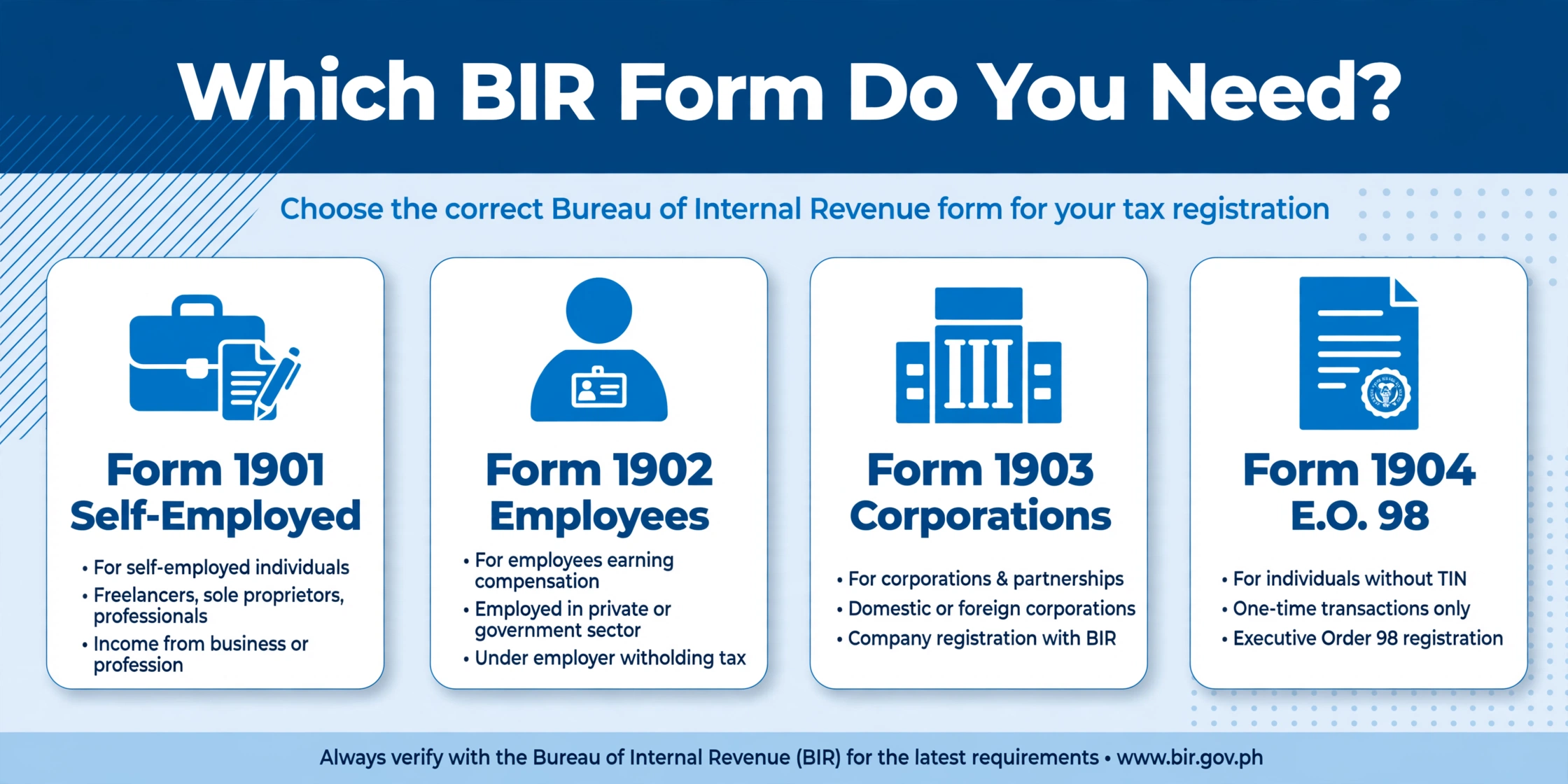
| Applicant Category | BIR Form | Purpose |
|---|---|---|
| Employed Individuals | 1902 | First-time employee TIN registration |
| Unemployed Individuals | 1904 | TIN issuance under E.O. 98 |
| Students | 1904 | Qualifying E.O. 98 transactions |
| First-Time Job Seekers | 1904 | Eligible pre-employment government transactions |
| Freelancers and Self-Employed | 1901 | Business or professional registration |
| Sole Proprietors | 1901 | Individual business registration |
| Licensed Professionals | 1901 | Professional tax registration |
| OFWs | 1904 | Eligible E.O. 98 or other applicable transactions |
| Foreign Employees | 1902 | Employee TIN registration |
| Nonresident Foreign Individuals | 1904 | Applicable E.O. 98 or one-time transactions |
| Corporations and Partnerships | 1903 | Non-individual taxpayer registration |
| Existing TIN Holders | 1905 | Registration updates, corrections, or cancellation |
Important: Forms 1901–1904 are used for applicable registration categories, particularly manual applications. Online registration may use different procedures through BIR ORUS. Form 1905 is for updating existing records, not obtaining a second TIN.
Identification and Supporting Documents by Applicant Type
The documents needed for TIN registration vary according to the applicant’s circumstances. Most individual applicants need valid identification and supporting documents appropriate to their registration category.
| Applicant Type | Main Identification | Additional Documents |
|---|---|---|
| Employees | Valid government-issued ID | Proof of address or marriage certificate, if applicable |
| Unemployed Individuals | Valid government-issued ID | Proof of address and transaction-related documents, when required |
| Students | BIR-accepted identification | Proof of address or other applicable documents |
| First-Time Job Seekers | Valid government-issued ID | Barangay Certification confirming first-time job seeker status |
| Freelancers | Valid government-issued ID | DTI registration and invoicing documents, if applicable |
| Sole Proprietors | Valid government-issued ID | DTI Certificate, if using a registered business name |
| Licensed Professionals | PRC ID and applicable identification | Proof of residential or business address, when required |
| OFWs | Valid government-issued ID or passport | Supporting documents based on registration purpose |
| Foreign Employees | Valid passport | Relevant entry or departure stamps, if applicable |
| Nonresident Foreign Individuals | Valid passport | Transaction documents and representative authorization, if applicable |
| Corporations and Partnerships | Applicable corporate registration documents | SEC certificate, articles of incorporation or partnership, and authorization documents when required |
Document preparation tips:
- Ensure your identification documents are readable and contain accurate personal information.
- Prepare proof of residence if your accepted ID does not show an address.
- Check whether original documents and photocopies are required for manual applications.
- For ORUS registration, prepare clear digital copies and the required selfie holding your ID, where applicable.
- Confirm category-specific requirements before visiting a BIR Revenue District Office (RDO).
Not every document listed above is mandatory for every applicant. The BIR may require different supporting documents depending on the taxpayer category and registration purpose.
Additional Requirements and Fees, Where Applicable
Getting a TIN is generally free for eligible individual applicants, but certain business registration transactions involve additional requirements and costs.
| Registration Type | Applicable Fee or Cost | Additional Requirements |
|---|---|---|
| Employee TIN Registration | Free | Employer-assisted registration, where applicable |
| E.O. 98 Registration | Free | Valid identification and qualifying registration purpose |
| Student or First-Time Job Seeker Registration | Free, if eligible under E.O. 98 | Applicable identification and supporting documents |
| Self-Employed Registration | ₱30 DST, where applicable | Certificate of Registration and invoicing compliance |
| Sole Proprietorship Registration | ₱30 DST, where applicable | Business documents and invoice-related requirements |
| Corporation or Partnership Registration | ₱30 DST, where applicable | SEC or equivalent registration and invoicing documents |
| Digital TIN ID Issuance | Free | Existing TIN, ORUS account, and compliant ID photograph |
| Existing TIN Registration Update | Depends on the transaction | BIR Form 1905 or applicable online update service |
Important information about BIR registration fees:
- TIN issuance: Generally free for eligible individual applicants.
- Digital TIN ID: Free through the official BIR ORUS portal.
- Documentary Stamp Tax (DST): ₱30 for applicable Certificate of Registration issuance.
- Invoice printing: Additional costs may apply to registered businesses.
- Annual Registration Fee: The former ₱500 BIR Annual Registration Fee was abolished effective January 22, 2024, under the Ease of Paying Taxes Act.
The ₱30 DST and business-related costs should not be confused with a fee for obtaining a personal TIN.
Remember: Individuals who already have a TIN should not register for another one. If you only need a Digital TIN ID, use your existing TIN through BIR ORUS.
For the latest application forms, documentary requirements, and registration fees, check the official BIR website before applying.
Online vs. In-Person TIN Application Requirements
Documents Needed for Online Registration Through BIR ORUS
The BIR ORUS portal allows eligible taxpayers to register online without visiting a Revenue District Office. Applicants must prepare valid identification, contact information, and any category-specific supporting documents before starting an online application.
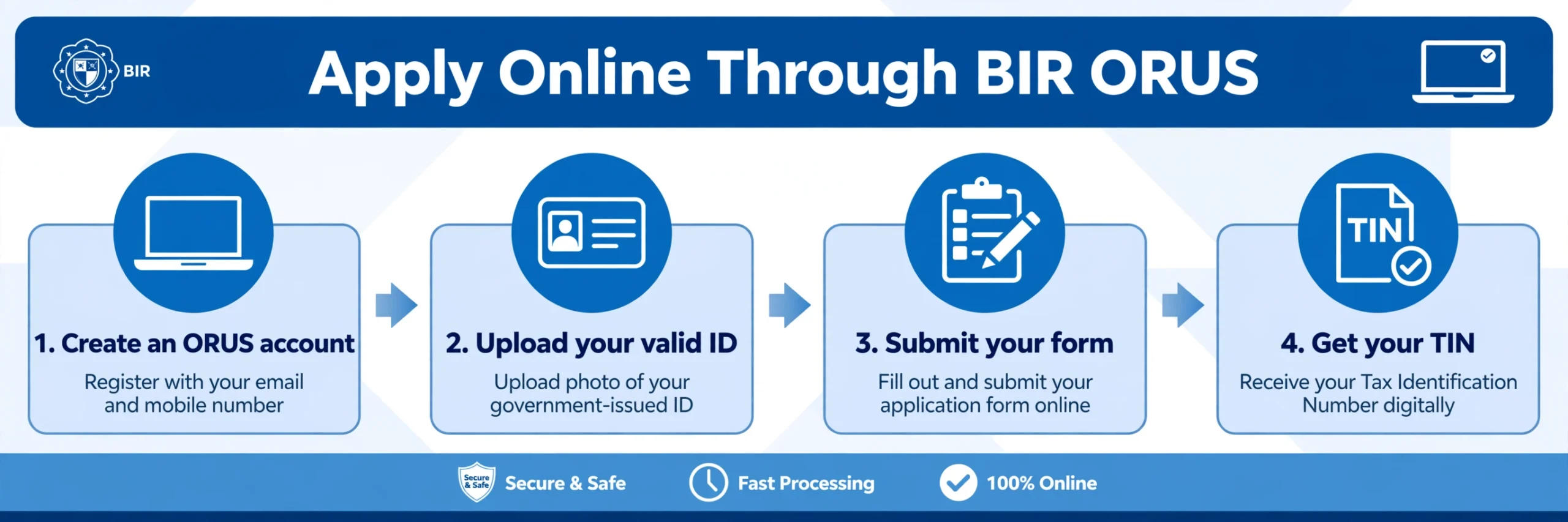
Common online TIN application requirements include:
- Active email address: Required for ORUS account creation, verification, and notifications.
- Valid government-issued ID: Such as a PhilID, passport, or driver’s license.
- Selfie holding your ID: Required for applicable online registration services.
- Proof of address: If your identification document does not show the required residential or business address.
- Personal information: Full name, birthdate, citizenship, and contact details.
- Business registration documents: DTI, SEC, PRC, or other supporting documents, when applicable.
- Additional requirements: Depending on your taxpayer classification and registration purpose.
How to prepare your documents:
- Scan or photograph the required identification documents clearly.
- Ensure your personal information matches your official ID.
- Prepare digital copies of any additional supporting documents.
- Visit the official BIR ORUS portal.
- Select the appropriate registration service and upload the documents requested.
Important: Not every taxpayer category follows the same ORUS procedure. Newly hired employees generally register through their employer’s ORUS service rather than applying individually online.
Documents Needed for Manual Registration at a BIR RDO
Applicants who need in-person TIN registration must submit their documents to the appropriate BIR Revenue District Office.
Manual registration may be necessary when online registration is unavailable, the taxpayer category is not supported online, or the applicant must complete an in-person transaction.
Common requirements for walk-in TIN registration include:
- Completed BIR registration form: Form 1901, 1902, 1903, or 1904, depending on the applicant’s classification.
- Original valid government-issued ID: For identity verification.
- Photocopy of identification: As specified in the BIR documentary checklist.
- Proof of residence or business address: If required.
- Additional supporting documents: Such as a Barangay Certification, business registration certificate, or passport, depending on the applicant’s category.
- Authorization documents: If an authorized representative is permitted to submit the application.
How to prepare for your RDO visit:
- Identify the correct Revenue District Office for your registration category.
- Complete the appropriate BIR application form.
- Prepare the required originals and photocopies.
- Check whether your transaction requires an appointment.
- Submit your documents at the designated registration counter.
For applicable manual registrations, the BIR generally requires two original copies of the registration form and one photocopy of the accepted identification document.
Incomplete applications may be returned until the missing requirements are provided.
Employer-Assisted TIN Registration Requirements
Newly hired employees without an existing TIN generally obtain their taxpayer number through their employer using the BIR ORUS Employer Service Link.
The employer must have an ORUS account enrolled in the applicable employer service.
Requirements for local employees may include:
- Valid government-issued ID showing the employee’s name, address, and birthdate.
- Proof of residence if the identification document does not show an address.
- Selfie holding the ID for applicable online registration.
- Marriage certificate for married female applicants, when required.
- BIR Form 1902 for manual employee registration, when applicable.
For foreign employees, the BIR generally requires a passport showing the biographical page and relevant entry or departure stamps, if applicable.
If ORUS is unavailable and an employer must process employee registrations manually, additional documents may include:
- Letter of Authority (LOA) signed by the company president or HR head.
- Identification documents of the authorized company representative and signatory.
- Transmittal list of newly hired employees.
- Printed ORUS error message, when the manual application is due to a technical issue.
Important: Employees who already have a TIN should provide their existing taxpayer number to their employer rather than applying for a new one.
When Personal Appearance or an Authorized Representative Is Required
The BIR allows authorized representatives for certain registration transactions, but some services require the taxpayer to appear personally.
The requirements depend on the transaction and whether the applicant is an individual or an organization.
When personal appearance may be required:
- Applying for a physical BIR TIN card.
- Replacing a lost or damaged physical TIN card.
- Completing transactions requiring in-person identity verification.
- Resolving registration issues when directed by the BIR.
For physical TIN card issuance, personal appearance is mandatory. An authorized representative cannot apply for the card on behalf of the taxpayer.
When an authorized representative is permitted, documents may include:
- Special Power of Attorney (SPA): Authorizing the representative to complete specific transactions for an individual taxpayer.
- Valid government-issued IDs: Identification documents of both the taxpayer and representative.
- Specimen signatures: Required on applicable identification copies or authorization documents.
- Board Resolution or Secretary’s Certificate: For corporate or organizational representatives.
- Authenticated or apostilled authorization: For certain foreign applicants, where required.
For applicable ORUS transactions involving representatives, a selfie of the authorized representative holding the ID may also be required.
Before authorizing another person, confirm that the BIR permits representation for your specific transaction.
Official registration resources:
- BIR ORUS — Online Taxpayer Registration
- BIR Official Website — Registration Requirements
- BIR TRRA Portal — Alternative Electronic Submission
Remember: Online TIN registration, manual TIN registration, and physical TIN card issuance are different procedures. Always check the requirements for your specific registration type.
Sources: BIR’s employee registration checklist, ORUS account guidance, manual business registration requirements, and BIR ORUS employer service documentation.
Requirements for a Digital TIN ID vs. Physical TIN Card
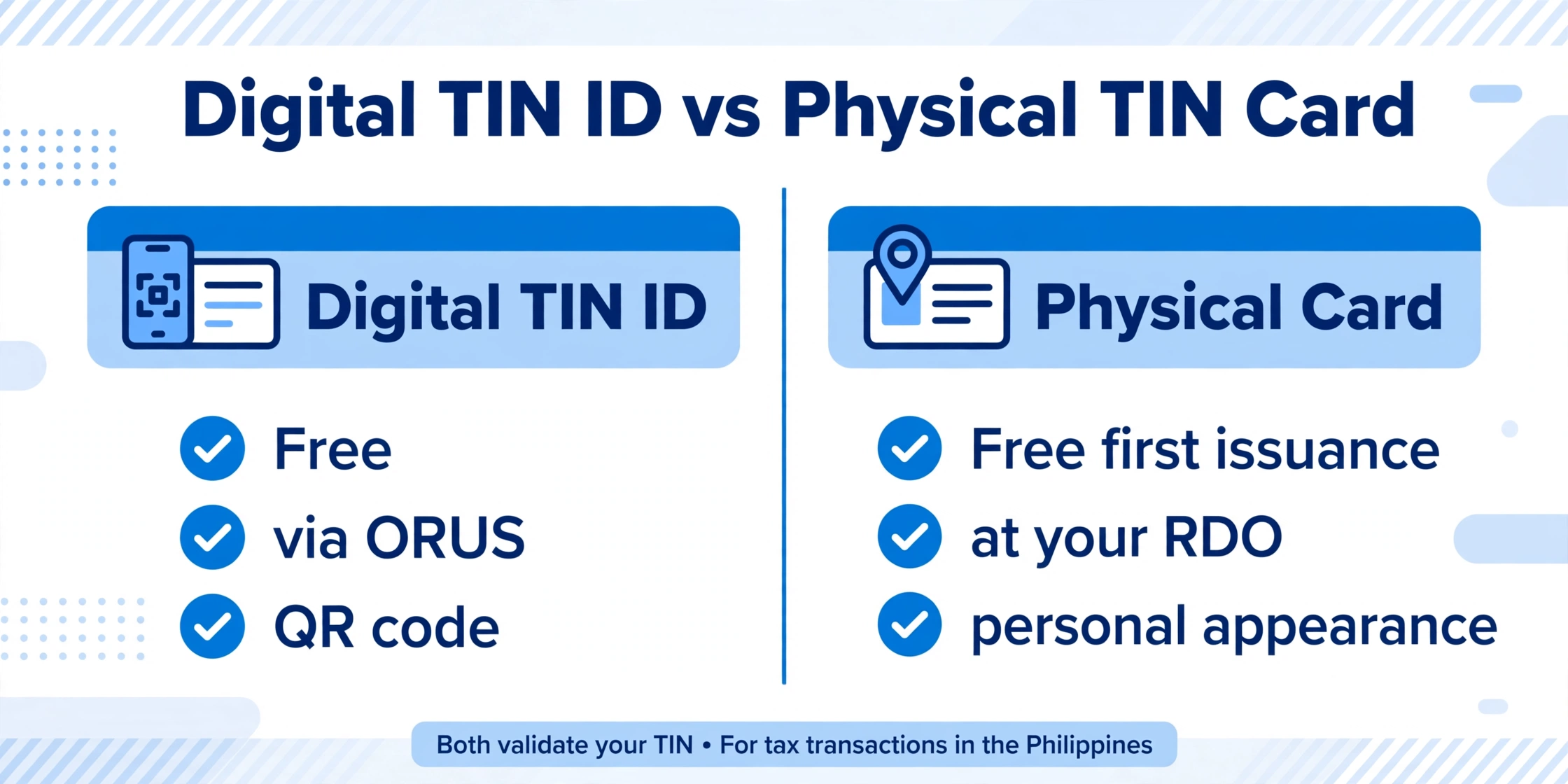
Requirements for Existing TIN Holders Applying for a Digital TIN ID
Individual taxpayers who already have a registered TIN can obtain a free Digital TIN ID through the BIR Online Registration and Update System (ORUS), even if they have never received a physical TIN card.
Basic requirements include:
- Existing TIN: A Taxpayer Identification Number already registered with the BIR.
- ORUS account: An active account linked to your taxpayer information.
- Registered email address: An email address correctly recorded in the BIR system.
- Recent ID photograph: A digital 1×1 photo meeting BIR specifications.
- Accurate personal details: Information consistent with your BIR registration records.
How to apply:
- Visit the official BIR ORUS portal.
- Log in or enroll using your existing taxpayer information.
- Access the Digital TIN ID service.
- Upload the required photograph.
- Review your information and generate your Digital TIN ID.
Important: You do not need to apply for another TIN or obtain a physical card before requesting a Digital TIN ID.
Digital TIN ID Photo and ORUS Account Requirements
BIR Digital TIN ID photo requirements are established under Revenue Memorandum Circular No. 120-2023. Applicants must upload a photograph that meets the BIR’s specifications.
Digital TIN ID photo specifications:
- Photo size: 1×1 inch.
- Background: Plain white without a border.
- Photo age: Taken within the previous six months.
- Face position: Looking directly at the camera, with both ears visible.
- Facial expression: Neutral expression or a smile without showing teeth.
- Visibility: Eyes open and face clearly visible.
- Accessories: Sunglasses, face masks, and accessories covering the face are generally not permitted.
- Head coverings: Allowed for religious reasons if the face remains visible, subject to BIR guidelines.
Photos that do not follow BIR specifications may not be accepted as valid Digital TIN ID photographs.
ORUS account requirements:
- Use an active email address registered with the BIR.
- Ensure your personal information matches your taxpayer records.
- Update outdated contact information through the appropriate BIR registration update procedure.
- Upload the required photograph through the Digital TIN ID service.
If your registered email needs updating, the BIR provides procedures using Form S1905 (Registration Update Sheet) through the appropriate RDO or authorized electronic submission channel.
The Digital TIN ID contains a QR code for online authentication and does not require a handwritten signature.
Under BIR guidelines, certain Digital TIN ID updates or regeneration requests are subject to a 30-day interval.
Requirements for First-Time Physical TIN Card Issuance
Taxpayers who prefer a traditional physical TIN ID card may request one from their registered BIR Revenue District Office.
According to the BIR’s documentary requirements, applicants must prepare:
- BIR Form 1905: One original completed application form.
- Recent 1×1 ID photograph: One original.
- Valid government-issued ID: Such as a PhilID, passport, or driver’s license.
- Photocopy of identification: One photocopy showing the applicant’s name, address, and birthdate.
- Proof of residence or business address: If the identification document does not show an address.
Important conditions:
- Personal appearance at the BIR office is mandatory.
- First-time issuance of a paper TIN card is free.
- Applicants must already have a registered TIN.
- The BIR may verify the taxpayer’s registration records before issuance.
A physical TIN card is not mandatory for taxpayers who already have a valid Digital TIN ID.
Requirements for Replacing a Lost or Damaged TIN ID
If your physical TIN card is lost, stolen, or damaged, you can request a replacement through your registered Revenue District Office.
Requirements for TIN ID replacement:
- BIR Form 1905: One original completed form.
- Recent 1×1 photograph: One original.
- Valid government-issued identification: With one photocopy.
- Proof of address: If the identification document does not show an address.
- Affidavit of Loss: One original when replacing a lost TIN card.
- Replacement fee: ₱100 for a lost or damaged physical TIN card.
How to request a replacement:
- Prepare BIR Form 1905 and the required identification documents.
- Obtain an Affidavit of Loss if your physical card is missing.
- Visit your registered BIR Revenue District Office personally.
- Submit your documents for verification.
- Pay the applicable replacement fee and follow the BIR’s issuance instructions.
Alternative option: If you already have a registered TIN, you may obtain a free Digital TIN ID through ORUS instead of replacing your physical card.
Both the Digital TIN ID and physical TIN card serve as proof of TIN ownership. For current requirements, check the BIR website, the ORUS portal, and the BIR Digital TIN ID guidelines under RMC No. 120-2023.
Common TIN Application Document Problems and How to Fix Them
No Valid Government-Issued ID
A valid government-issued identification document is generally required for TIN registration. Applicants who do not have an accepted ID may experience difficulties completing identity verification.
How to fix this problem:
- Check whether you have a PhilID, ePhilID, passport, driver’s license, or another BIR-accepted government-issued ID.
- Ensure your identification shows the personal information required by the BIR.
- Obtain an accepted identification document before applying, if necessary.
- Contact your assigned RDO to confirm acceptable identification alternatives for your registration category.
Important: A school ID, birth certificate, or Barangay Certification should not automatically be considered a substitute for a BIR-accepted government-issued ID.
Missing or Unacceptable Proof of Address
Proof of residential or business address may be required when your identification document does not show your address or when additional address verification is needed.
Common problems include:
- The submitted ID does not display an address.
- The address on the application differs from supporting documents.
- The proof of residence or business address is incomplete.
- The submitted document does not meet the applicable BIR requirements.
How to fix this problem:
- Check whether your government-issued ID contains your current address.
- Prepare additional proof of residence or business address if required.
- Ensure the address matches your registration information.
- Ask your RDO which supporting documents are accepted for your taxpayer category.
For business registration, the BIR may require proof of address under the applicant’s name.
Incorrect Name, Birthdate, or Personal Information
Incorrect personal details can cause TIN application errors or mismatched taxpayer records in the BIR registration system.
Common mistakes include:
- Misspelled first name, middle name, or surname.
- Incorrect date of birth.
- Inconsistent marital status or registered name.
- Wrong residential or business address.
- Incorrect taxpayer classification.
How to fix this problem:
- Compare your application details with your official identification documents.
- Correct typing errors before submitting your ORUS application.
- Use the appropriate BIR registration update procedure if your existing records contain errors.
- Submit supporting documents for changes to your registered name or other personal details when required.
BIR Form 1905 is used for applicable registration information updates and corrections. Some changes can be processed through ORUS, while others require an RDO visit.
Blurry, Expired, or Rejected Identification Documents
Unreadable or unacceptable ID documents may prevent successful TIN registration, particularly when applying online through BIR ORUS.
The BIR requires submitted identification documents to be readable, untampered, and consistent with the applicant’s registration information.
How to avoid document rejection:
- Upload a clear photograph or scanned copy of your ID.
- Ensure your full name, birthdate, and other required details are visible.
- Avoid blurry, cropped, or heavily compressed images.
- Check that your identification is valid and acceptable for the transaction.
- Do not submit altered or damaged identification documents.
- Follow the file format and upload instructions displayed in ORUS.
For online registration categories requiring a selfie holding your government-issued ID, make sure both your face and identification document are visible.
If a document is rejected, review the BIR’s instructions before uploading a replacement.
Missing Supporting Documents or Incorrect BIR Forms
Submitting the wrong BIR registration form or incomplete supporting documents can delay your application.
The required form depends on your taxpayer classification:
- BIR Form 1901: Self-employed individuals, freelancers, professionals, and mixed-income earners.
- BIR Form 1902: Employees earning compensation income.
- BIR Form 1903: Corporations, partnerships, cooperatives, and other covered organizations.
- BIR Form 1904: E.O. 98 applicants and certain one-time taxpayers.
How to fix this problem:
- Identify your correct taxpayer classification.
- Confirm which registration form applies to your circumstances.
- Review the official BIR documentary requirements checklist.
- Prepare missing documents, such as business registration certificates, proof of address, or authorization documents.
- Resubmit your application according to the instructions provided by the BIR.
For manual applications, the RDO may return incomplete documents and identify the missing requirements.
Existing TIN Records and Duplicate Registration Issues
Every taxpayer in the Philippines is allowed only one Taxpayer Identification Number. Applying for another TIN when one has already been issued is prohibited under Philippine tax law.
Duplicate registration issues may occur when applicants:
- Forget a TIN issued by a previous employer.
- Apply for another TIN after changing jobs.
- Register for a new TIN when starting a business.
- Submit another application because their existing TIN cannot be found.
- Enter personal details that do not match their existing BIR records.
How to resolve existing TIN or duplicate registration problems:
- Check previous employment documents, TIN cards, or tax records for your existing number.
- Use official BIR TIN inquiry or verification services.
- Contact your current or previous employer if necessary.
- Visit the appropriate RDO if your taxpayer records cannot be verified.
- If multiple TINs already exist, coordinate with the RDO where the duplicate records are registered to resolve the issue.
Important: Do not apply for another TIN simply because your original number is missing or your online application was rejected.
For official assistance with TIN registration, document verification, or taxpayer record corrections, visit the BIR website or the BIR ORUS portal. Always follow the requirements for your specific taxpayer classification before submitting or correcting an application.
Frequently Asked Questions About TIN ID Requirements
Can I Apply for a TIN ID Without a Job?
Yes, you can apply for a TIN in the Philippines even if you are unemployed. Under Executive Order No. 98 (E.O. 98), individuals who need a TIN for qualifying government transactions can register without employment.
Eligible applicants generally need:
- BIR Form 1904 for manual registration.
- A valid government-issued ID.
- Proof of residence if their ID does not show an address.
- Additional supporting documents, when applicable.
You must have a qualifying registration purpose. Being unemployed alone does not automatically require TIN registration.
What Are the TIN ID Requirements for First-Time Applicants?
First-time TIN applicants generally need a valid government-issued ID, the correct BIR registration form, and supporting documents based on their taxpayer category.
Common requirements include:
- Valid ID: PhilID, passport, driver’s license, or another BIR-accepted identification document.
- BIR application form: Form 1901, 1902, 1903, or 1904, depending on the applicant category.
- Proof of address: If the accepted identification document does not display an address.
- Additional documents: Employment, business, or transaction-related records, when required.
Online applicants may also need an active email address and a selfie holding their ID for identity verification.
Can Students Get a TIN Without Employment?
Yes, students can obtain a TIN without being employed if they qualify under E.O. 98 or another applicable BIR registration category.
Students may need taxpayer identification for certain government transactions or when preparing for employment.
For eligible E.O. 98 registration, applicants generally need BIR Form 1904, accepted identification, and supporting documents when required.
However, being enrolled in school does not automatically make TIN registration mandatory.
Is a Birth Certificate Enough to Apply for a TIN?
A birth certificate alone is generally not sufficient for standard TIN registration. The BIR normally requires an accepted government-issued identification document showing the applicant’s name, birthdate, and address.
A Philippine Statistics Authority (PSA) birth certificate may help support personal information in certain cases, but it should not be treated as a complete replacement for a valid ID.
Applicants without an accepted ID should contact their assigned Revenue District Office (RDO) to confirm acceptable alternatives.
Do I Need a Barangay Certificate for TIN Registration?
A Barangay Certificate is not required for every TIN application. However, first-time job seekers registering under the applicable BIR requirements must provide a Barangay Certification confirming their status.
Other applicants may need separate proof of address if their government-issued ID does not show their current address.
Always check the documentary requirements for your specific taxpayer category before obtaining additional documents.
Can I Apply for a TIN Without Proof of Address?
Yes, you may apply without a separate proof-of-address document if your accepted government-issued ID already shows your current address.
However, additional address verification may be necessary when:
- Your ID does not display an address.
- Your registered address differs from your supporting documents.
- Your business registration requires proof of a business location.
- The BIR requests additional documentation.
The accepted proof of residence or business address depends on the taxpayer classification and applicable BIR requirements.
Can Foreigners Apply for a Philippine TIN?
Yes, eligible foreign nationals can obtain a Philippine TIN when they have employment, business, tax, or qualifying transaction requirements in the Philippines.
Eligible applicants may include:
- Foreign employees working in the Philippines.
- Resident aliens conducting taxable activities.
- Foreign entrepreneurs and self-employed professionals.
- Nonresident foreigners receiving certain Philippine-source income.
Foreign applicants generally need a valid passport and supporting documents appropriate to their registration category.
For certain nonresident taxpayers, a withholding agent may apply for the TIN on their behalf.
Do I Need a New TIN When Starting a Business?
No, individuals who already have a TIN do not need another one when starting a sole proprietorship or professional practice. They must use their existing taxpayer number and update their BIR registration to reflect their business or professional activities.
For applicable manual registration, self-employed individuals and sole proprietors generally use BIR Form 1901.
Corporations and partnerships are different because they are separate legal entities that require their own TIN.
The BIR permits only one TIN per taxpayer, so existing individual taxpayers must not obtain duplicate TINs.
Are the Requirements Different for Online and Walk-In Applications?
Yes, online and walk-in TIN applications generally require similar supporting documents, but the submission method and verification process differ.
| Requirement | Online Through ORUS | Walk-In at BIR RDO |
|---|---|---|
| Registration details | Electronic application | Applicable paper BIR form |
| Valid identification | Digital copy | Original ID and required photocopy |
| Proof of address | Uploaded if required | Submitted if required |
| Identity verification | Selfie holding ID, where applicable | In-person document verification |
| Supporting documents | Electronic uploads | Originals or photocopies as specified |
Some taxpayer categories require employer-assisted registration or other specific procedures. Not every category follows the same online or walk-in process.
Do I Need Documents to Get a Digital TIN ID if I Already Have a TIN?
Yes, existing TIN holders must meet the Digital TIN ID requirements, but they do not need to register for a new TIN.
Under BIR Revenue Memorandum Circular No. 120-2023, individual taxpayers need:
- Existing TIN: A taxpayer number already issued by the BIR.
- ORUS account: An account enrolled using their registered taxpayer information.
- Registered email: An email address correctly reflected in BIR records.
- Recent 1×1 photograph: A clear photo with a white background, taken within the previous six months.
- Accurate taxpayer information: Personal details matching existing BIR records.
Eligible taxpayers can generate and download their free Digital TIN ID through the official BIR ORUS portal, even if they have never received a physical TIN card.
Final TIN ID Requirements Checklist Before Applying
Before submitting your TIN application, use this final checklist to confirm that you have prepared the correct documents and completed the required steps.
Confirm Your Eligibility
- You have identified your correct taxpayer category.
- You have a valid reason for TIN registration.
- You do not already have a registered TIN.
- You have confirmed whether you need to register online or in person.
- You have checked the latest BIR requirements for your category.
Prepare Your Documents
| Document | Prepared? |
|---|---|
| Valid government-issued ID | ☐ |
| Correct BIR registration form | ☐ |
| Proof of residence or business address, if required | ☐ |
| Additional supporting documents, if applicable | ☐ |
| Photocopies for manual applications, if required | ☐ |
| Clear digital copies for online applications, if required | ☐ |
Verify Your Existing TIN
Before applying, verify that you do not already have a TIN. Applying for a second TIN is prohibited under Philippine tax law. If you already have a TIN, use your existing number or update your registration information instead of submitting a new application.
Confirm the Latest BIR Requirements
BIR registration requirements may change. Before submitting your application, check the official BIR website or BIR ORUS portal for the latest forms, documentary requirements, and registration procedures.
Final Reminder
Preparing the correct documents, verifying your existing TIN, and following official BIR instructions will help you avoid delays and complete your application successfully.